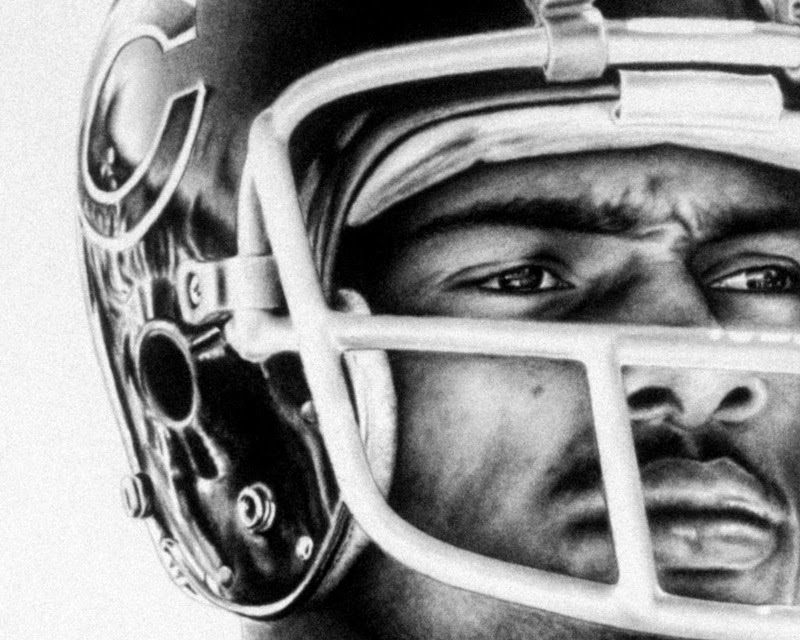
You can go through the annals of history and it will be documented that the vast majority of greatness came about as a result of long, hard, dedicated work -- at times unsupervised -- because of the desire of the individual to excel.
"I found this sandbank by the Pearl River near my hometown of Columbia, Mississippi. I laid out a course of 65 yards or so. Sixty-five yards on sand is like 120 on turf. But running on sand helps you make your cuts at full speed. I try to pick the heat of the day to run in, but sometimes the sand will get so hot you can't stand in place. It'll blister your feet. You get to the point where you have to keep pushing yourself. You stop, throw up, and push yourself again. There's no one to feel sorry for you."
-Walter Payton
Wednesday, June 18, 2014
Tuesday, June 17, 2014
Thursday, June 12, 2014
LIMITATIONS ARE ONLY IN YOUR MIND
A big thanks to Coach Dale Brown for forwarding this to me via email. Coach Brown never misses an opportunity to motivate or inspire.
Labels:
Attitude,
Character,
Determination,
Mental Approach,
Toughness
Wednesday, June 11, 2014
TALENT IS NEVER ENOUGH
The following came from an email newsletter from John Maxwell. His book "Talent Is Never Enough" is one that I always recommend to student-athletes to read. In fact, it was an assigned book to read by our team during last season in our run to an Elite Eight. Here is what Maxwell said today:
Talent is never enough. There’s no substitute for it, but there’s also no guarantee of success with it. To turn talent into influence, a person must prepare it with hard work, surround it with the right relationships, strengthen it by taking responsibility, and protect it with character.
Preparation Positions Your Talent
Author Emile Zola spoke truly when he said, “The artist is nothing without the gift, but the gift is nothing without work.” Preparation positions you so that when opportunity comes, your talent can shine. “Talent alone won’t make you a success,” Johnny Carson once remarked. “Neither will being in the right place at the right time, unless you are ready. The most important question is: Are you ready?”
Relationships Influence Your Talent
People knew LeBron James had special talent when he was a teenager. His high school basketball games were televised on ESPN. He was considered a future hall-of-fame ballplayer before he even turned pro.
Marcus Dupree was like LeBron James, only on the football field. A running back from small-town Mississippi, Dupree had it all as an athlete: size, speed, power, and grace. All of the top college programs invested heavily in his recruitment. Some blatantly disregarded collegiate rules when recruiting him, illegally provided him with money to influence his decision of where to attend school. The University of Oklahoma even sent an assistant coach to live in Dupree’s hometown of Philadelphia for six weeks in an effort to win his commitment.
Yet despite flashes of brilliance, Dupree never made it big. A movie about his life proclaims him as The Best That Never Was. Perhaps the main reason Dupree never capitalized on his remarkable talent was his relationships. Everyone close to Dupree—his extended family, friends, and coaches—wanted to profit from his success. Instead of adding value to Marcus, they sought to extract it from him. Without an encouraging support system, Dupree faltered the first time he encountered adversity and never fully recovered.
Responsibility Strengthens Your Talent
The ESPN documentary, Broke, examines why so many professional athletes, despite signing multimillion dollar contracts, find themselves penniless when their playing days are over. According to the film, “By the time they have been retired for two years, 78 percent of former NFL players have gone bankrupt or are under financial stress; within five years of retirement, an estimated 60 percent of former NBA players are broke.”
Regrettably, these athletes never learned to manage their money. Their reckless spending prevented them from enjoying the financial stability that their talent should have secured for them. They enjoyed the momentary pleasures accompanying their ability without taking responsibility for their future wellbeing.
Character Protects Your Talent
Figure skater Tonya Harding, golfer John Daly, sprinter Marion Jones, and cyclist Lance Armstrong…each of these athletes had dazzling ability, but lacked the character to sustain it. Overcome by jealousy, Harding hired a hitman to attack her rival, Nancy Kerrigan, thereby sacrificing her shot at Olympic stardom. Daly won the PGA Championship as a rookie, and the British Open a few years later, but his off-course drinking problems kept him from winning as much as his talent merited. Both Jones and Armstrong gave in to the temptation to supplement their natural talents with performance enhancing drugs. While the decision brought them victories in the short-run, each eventually got caught and suffered a fall from grace.
Thought to Ponder
When have you seen talent squandered? What was the reason why someone’s ability went to waste?
Talent is never enough. There’s no substitute for it, but there’s also no guarantee of success with it. To turn talent into influence, a person must prepare it with hard work, surround it with the right relationships, strengthen it by taking responsibility, and protect it with character.
Preparation Positions Your Talent
Author Emile Zola spoke truly when he said, “The artist is nothing without the gift, but the gift is nothing without work.” Preparation positions you so that when opportunity comes, your talent can shine. “Talent alone won’t make you a success,” Johnny Carson once remarked. “Neither will being in the right place at the right time, unless you are ready. The most important question is: Are you ready?”
Relationships Influence Your Talent
People knew LeBron James had special talent when he was a teenager. His high school basketball games were televised on ESPN. He was considered a future hall-of-fame ballplayer before he even turned pro.
Marcus Dupree was like LeBron James, only on the football field. A running back from small-town Mississippi, Dupree had it all as an athlete: size, speed, power, and grace. All of the top college programs invested heavily in his recruitment. Some blatantly disregarded collegiate rules when recruiting him, illegally provided him with money to influence his decision of where to attend school. The University of Oklahoma even sent an assistant coach to live in Dupree’s hometown of Philadelphia for six weeks in an effort to win his commitment.
Yet despite flashes of brilliance, Dupree never made it big. A movie about his life proclaims him as The Best That Never Was. Perhaps the main reason Dupree never capitalized on his remarkable talent was his relationships. Everyone close to Dupree—his extended family, friends, and coaches—wanted to profit from his success. Instead of adding value to Marcus, they sought to extract it from him. Without an encouraging support system, Dupree faltered the first time he encountered adversity and never fully recovered.
Responsibility Strengthens Your Talent
The ESPN documentary, Broke, examines why so many professional athletes, despite signing multimillion dollar contracts, find themselves penniless when their playing days are over. According to the film, “By the time they have been retired for two years, 78 percent of former NFL players have gone bankrupt or are under financial stress; within five years of retirement, an estimated 60 percent of former NBA players are broke.”
Regrettably, these athletes never learned to manage their money. Their reckless spending prevented them from enjoying the financial stability that their talent should have secured for them. They enjoyed the momentary pleasures accompanying their ability without taking responsibility for their future wellbeing.
Character Protects Your Talent
Figure skater Tonya Harding, golfer John Daly, sprinter Marion Jones, and cyclist Lance Armstrong…each of these athletes had dazzling ability, but lacked the character to sustain it. Overcome by jealousy, Harding hired a hitman to attack her rival, Nancy Kerrigan, thereby sacrificing her shot at Olympic stardom. Daly won the PGA Championship as a rookie, and the British Open a few years later, but his off-course drinking problems kept him from winning as much as his talent merited. Both Jones and Armstrong gave in to the temptation to supplement their natural talents with performance enhancing drugs. While the decision brought them victories in the short-run, each eventually got caught and suffered a fall from grace.
Thought to Ponder
When have you seen talent squandered? What was the reason why someone’s ability went to waste?
Labels:
Accountability,
Attitude,
Character,
Responsibility,
Work Ethic
Monday, May 26, 2014
COACH DON MEYER'S FOUR TYPES OF PLAYERS
Unconscious & Incompetent: These types of players "don’t know that they don’t know." They aren’t even aware that they don’t have a feel for the game. These players aren’t going to contribute on a winning team.
Conscious & Incompetent: These players now realize that "they know they don’t have it." These players still don’t have a feel for the game and are lacking in the skill department but they realize where their weaknesses are and can now begin to improve Awareness is the beginning of correction.
Unconscious & Competent: The most difficult level to reach, this player can perform the skills without having to think about them. For this type of player, the game naturally "flows."
Labels:
Accountability,
Attitude,
Coach Meyer,
Commitment,
Mental Approach
Tuesday, May 20, 2014
Wednesday, May 7, 2014
LESSONS THAT CAN BE LEARNED FROM KD's MVP ACCEPTANCE SPEECH
As a player, what can you learn from Kevin Durrant's MVP acceptance speech?
1. You can see a true vision of what humility looks like and sounds like.
2. You can see how an MVP takes an individual award and turn it into a team award.
3. You can see from text messages, written notes and conversations, how teammates can lift a player to a higher level.
4. The importance of family.
5. Preparation -- in terms of what he wanted to say and the message he wanted to convey.
1. You can see a true vision of what humility looks like and sounds like.
2. You can see how an MVP takes an individual award and turn it into a team award.
3. You can see from text messages, written notes and conversations, how teammates can lift a player to a higher level.
4. The importance of family.
5. Preparation -- in terms of what he wanted to say and the message he wanted to convey.
Labels:
Attitude,
Humility,
Love of the Game,
Success,
Teammates
Thursday, May 1, 2014
GRIFFIN LEARNS ABOUT WORK ETHIC FROM PAST NBA GREATS
The following is an excerpt of a story on the Clippers Blake Griffin that was written by Robert Morales of the Long Beach Telegraph. The story speaks to how Griffin has not only heard about the work ethic of the great players before him but has used it to model his own work ethic.
“I’ve heard millions of Kobe (Bryant) stories about late-night workouts,” said Griffin, whose team takes on Detroit on Saturday at 7:30 p.m. at Staples Center. “One I heard, one time I guess he was in Italy and called Marco Belinelli (of the Spurs) at like 1, 2 o’clock in the morning and asked him if he had a gym for him, and so Marco found him one and he went there to shoot with him.
“And he (Belinelli) was like, ‘I thought we were going to just get some shots up, but we had like a full workout.’ Things like that. That’s work ethic, real worth ethic. It’s not just coming in when you have to and going hard. It’s doing extra, going above and beyond.”
Griffin hangs his hat on that credo.
“Work ethic has always been a big part of what I do,” he said. “I’m a firm believer, the more work you put in, the more you get out. You know, I love hearing stories about the Kobe’s and the LeBron’s and back in the day, Michael Jordan, how they work and how sometimes they’re a little different about it. That’s what makes them unique.”
“I’ve heard millions of Kobe (Bryant) stories about late-night workouts,” said Griffin, whose team takes on Detroit on Saturday at 7:30 p.m. at Staples Center. “One I heard, one time I guess he was in Italy and called Marco Belinelli (of the Spurs) at like 1, 2 o’clock in the morning and asked him if he had a gym for him, and so Marco found him one and he went there to shoot with him.
“And he (Belinelli) was like, ‘I thought we were going to just get some shots up, but we had like a full workout.’ Things like that. That’s work ethic, real worth ethic. It’s not just coming in when you have to and going hard. It’s doing extra, going above and beyond.”
Griffin hangs his hat on that credo.
“Work ethic has always been a big part of what I do,” he said. “I’m a firm believer, the more work you put in, the more you get out. You know, I love hearing stories about the Kobe’s and the LeBron’s and back in the day, Michael Jordan, how they work and how sometimes they’re a little different about it. That’s what makes them unique.”
Labels:
Attitude,
Michael Jordan,
Practice,
Work Ethic
Tuesday, April 8, 2014
THE DEFINITION OF SUCCESS
The following comes from "The Champion's Mind" by Jim Afremow:
"My favorite description of what excellence in the sports world looks like comes Anson Dorrance, the legendary University of North Carolina women's soccer coach. He was driving to work early one morning, and as he passed a deserted field, he noticed one of his players off in the distance doing extra training by herself. He kept driving, but he later left a note in her locker: "The vision of a champion is someone who is bent over, drenched in sweat, at the point of exhaustion when no one else is watching."
The young woman, Mia Hamm, would go on to become one of the great players in the history of the sport.
"My favorite description of what excellence in the sports world looks like comes Anson Dorrance, the legendary University of North Carolina women's soccer coach. He was driving to work early one morning, and as he passed a deserted field, he noticed one of his players off in the distance doing extra training by herself. He kept driving, but he later left a note in her locker: "The vision of a champion is someone who is bent over, drenched in sweat, at the point of exhaustion when no one else is watching."
The young woman, Mia Hamm, would go on to become one of the great players in the history of the sport.
Labels:
Commitment,
Determination,
Mental Toughness,
Passion,
Responsibility,
Success,
Work Ethic
Saturday, February 22, 2014
HOW MOTIVATED ARE TO YOUR WORK: WIN OR LOSE
"After
every game, I used to ask Michael (Jordan) one question: Five, six, or seven? As in what
time are we hitting the gym tomorrow morning. And he’d snap back a time and
that was it. Especially after a loss, when there wasn’t a whole lot to say. No
discussion, no debate, no lame attempt to convince me he needed the morning
off. You good? I’m good. See you in the morning. And the next morning at
whatever time he’d decided, he’d awaken to find me standing outside his door.
No matter what happened the night before-good game, bad game, soreness,
fatigue- he was up working out every morning while most of the other guys
slept."
From "Relentless" by Tim Grover
Labels:
Attitude,
Mental Toughness,
Michael Jordan,
Self-Improvement,
Work Ethic
Thursday, February 6, 2014
SABAN ON IT TAKES TO BE A GOOD PLAYER
"To be a good player on your team, you have to affect someone else on the team. You have to cause them to play better by the way you play. You affect other players with the character and attitude. To be a great player, you have to affect your entire unit. If you are a great player, every player on that unit plays better when you are on the field. The number one thing on any team that will keep your players from being selfish is respect for the other players. Having respect leads to trust and from that they begin to believe in each other. That is the way it works and that is the way it has to be."
-Nick Saban
Thursday, January 16, 2014
Tuesday, January 14, 2014
BE THE BEST YOU
Labels:
Attitude,
Character,
Confidence,
Determination,
Discipline,
Enthusiasm,
Toughness
DO THE SOMETHING THAT YOU CAN DO
We ran across the words of poet Everett Hall and thought what a wonderful mindset for players. It doesn't matter what your role is with your team. Maybe you are a starter that is expected to continually set screens for your shooters. Maybe you are the first sub off the bench expected to come in and be lockdown defender. Maybe you are someone who gets in the game only when the margin of victory or defeat merits it.
Let's take it a step further. Maybe you aren't even a player. Maybe your are a manager. Maybe you are the person that films the games or keeps the stats.
Whatever your role is with the team it is important and valuable -- even if you don't see it or realize it.
As Everett Hall wrote:
I am only one,
But still I am one.
I cannot do everything
But still I can do something;
And because I cannot do everything
I will not refuse to do the something that I can do.
If you are the starter counted on to screen -- be the best screener in your conference. Execute your screening angles as well as any player before you.
If you are the lockdown defender coming off the bench -- be the best lockdown defender your program has ever had. Come off the bench with intensity and determination to not allow your man to score.
If you rarely play except when the game is already decided -- be the most enthusiastic player on your bench. Be the person that lights the fire under those that play.
If you are a manager, statistician or video person -- make sure no one does their job better than you.
"I will not refuse to do the something that I can do."
Let's take it a step further. Maybe you aren't even a player. Maybe your are a manager. Maybe you are the person that films the games or keeps the stats.
Whatever your role is with the team it is important and valuable -- even if you don't see it or realize it.
As Everett Hall wrote:
I am only one,
But still I am one.
I cannot do everything
But still I can do something;
And because I cannot do everything
I will not refuse to do the something that I can do.
If you are the starter counted on to screen -- be the best screener in your conference. Execute your screening angles as well as any player before you.
If you are the lockdown defender coming off the bench -- be the best lockdown defender your program has ever had. Come off the bench with intensity and determination to not allow your man to score.
If you rarely play except when the game is already decided -- be the most enthusiastic player on your bench. Be the person that lights the fire under those that play.
If you are a manager, statistician or video person -- make sure no one does their job better than you.
"I will not refuse to do the something that I can do."
Labels:
Attitude,
Role Development,
Teammates,
Teamwork,
Work Ethic
Sunday, December 29, 2013
TEAM STRENGTH
"As long as you brothers support one another and render assistance to one another, your enemies can never gain victory over you. But if you fall away from one another, you can be broken like a frail arrow, one at a time."
-Genghis Khan
(Taken from the book "Damn Few" by Rorke Denver
-Genghis Khan
(Taken from the book "Damn Few" by Rorke Denver
Subscribe to:
Posts (Atom)


